
2026
WeChat Channels × AI
A design challenge for the Tencent WeChat Channels team — rethinking video creation with AI, moving from clip assembly toward true human–AI co-creation.
- Timeline
- Mar 2026
- Team
- Solo
- Role
- Product Designer
- Methods
- Trend & competitive analysis, speculative design, interactive prototype
Research questionWhat does video creation look like when AI co-creates across the whole flow, instead of optimizing single tools — and how does the creator stay the author?
Abstract
Channels' “one-tap video” stitches clips into a template. It doesn't create.
For a Tencent WeChat Channels design challenge, I examined how AI is entering short-video creation, where current tools fall short, and what everyday creators struggle with. I propose a redesign in two parts — AI one-tap video and AI editing — that embeds AI into the moments creators already pass through, moving from instruction-based tools toward conversational co-creation. The work ends in three principles for bringing AI into a familiar creative flow without taking authorship away from people.
Context
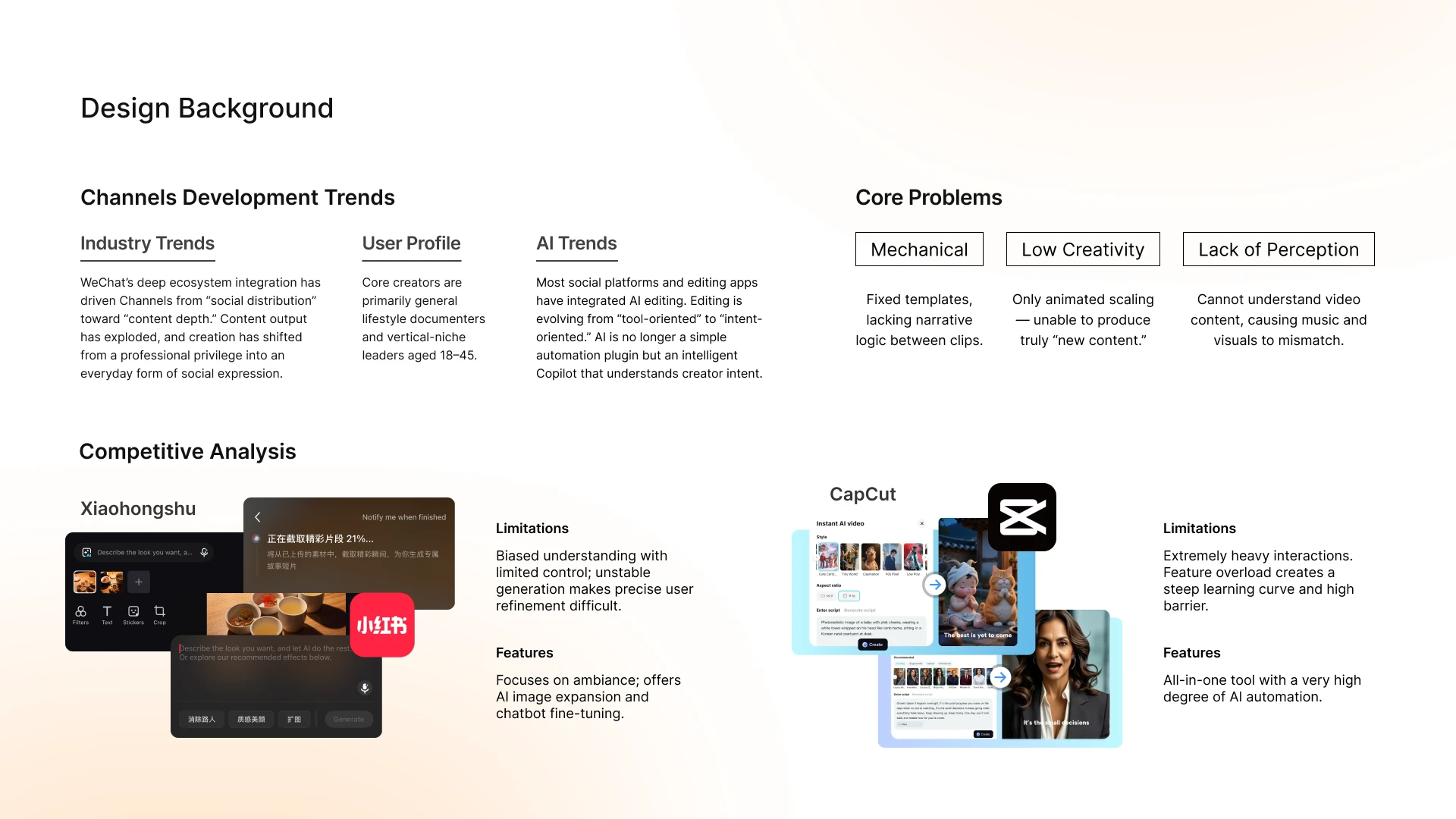
Editing is shifting from “tool-oriented” to “intent-oriented”: AI is becoming a copilot that understands what a creator wants, not an automation plugin.
WeChat's ecosystem has pushed Channels from social distribution toward content depth, and creation has become an everyday form of social expression. Its core creators are general lifestyle documenters and niche leaders aged 18–45 — most without scripting knowledge, filming gear, or editing skills.
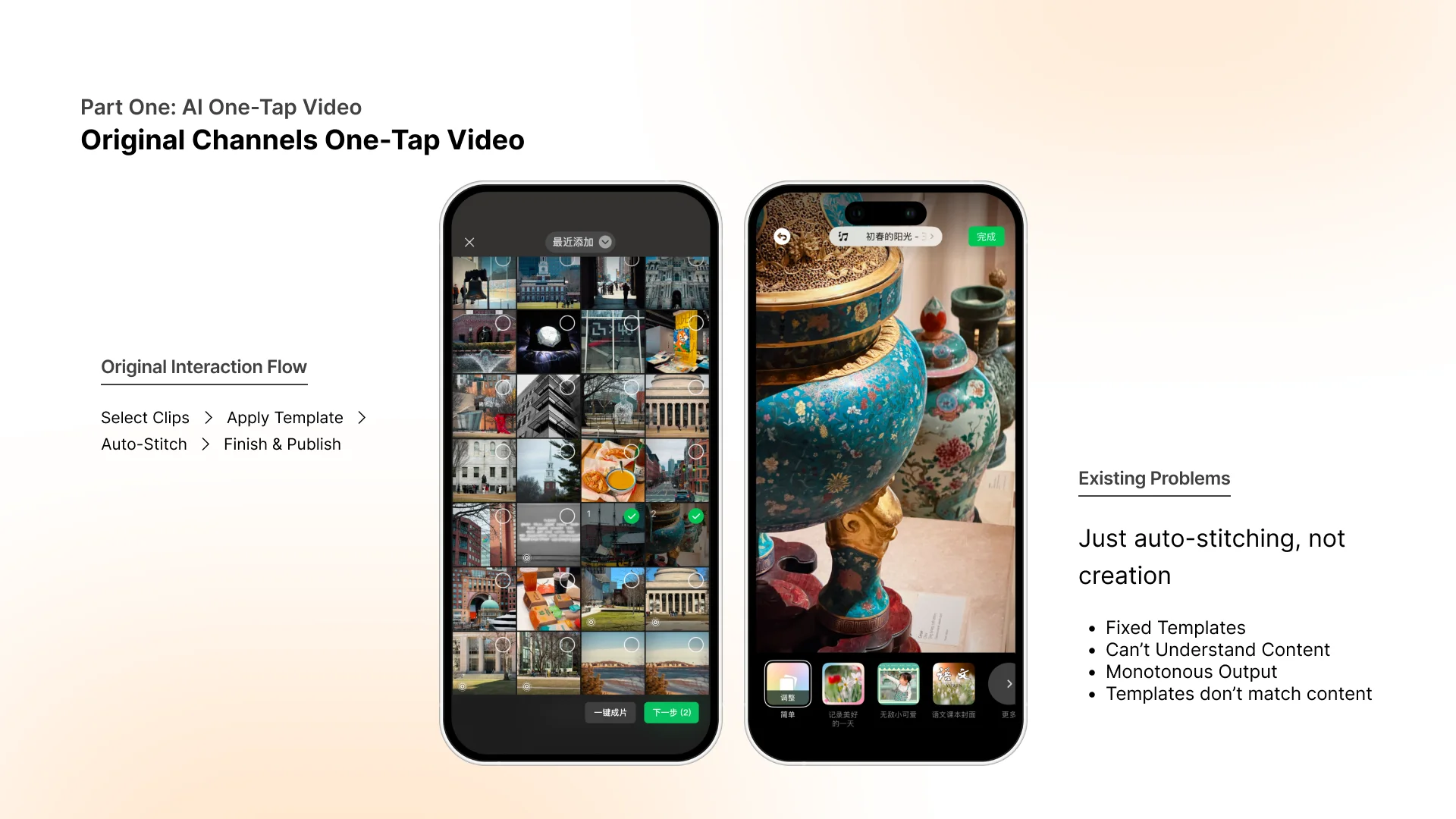
Three problems with current one-tap video
Mechanical — fixed templates with no narrative logic between clips. Low creativity — animated scaling, not new content. No perception — the system can't understand the video, so music and visuals mismatch.
How others approach it
Xiaohongshu focuses on ambiance, with AI image expansion and chat-based refinement, but generation is unstable and hard to control precisely. CapCut offers a highly automated all-in-one tool, but feature overload creates a steep learning curve. Neither pairs strong generation with lightweight, controllable interaction.
Design goals
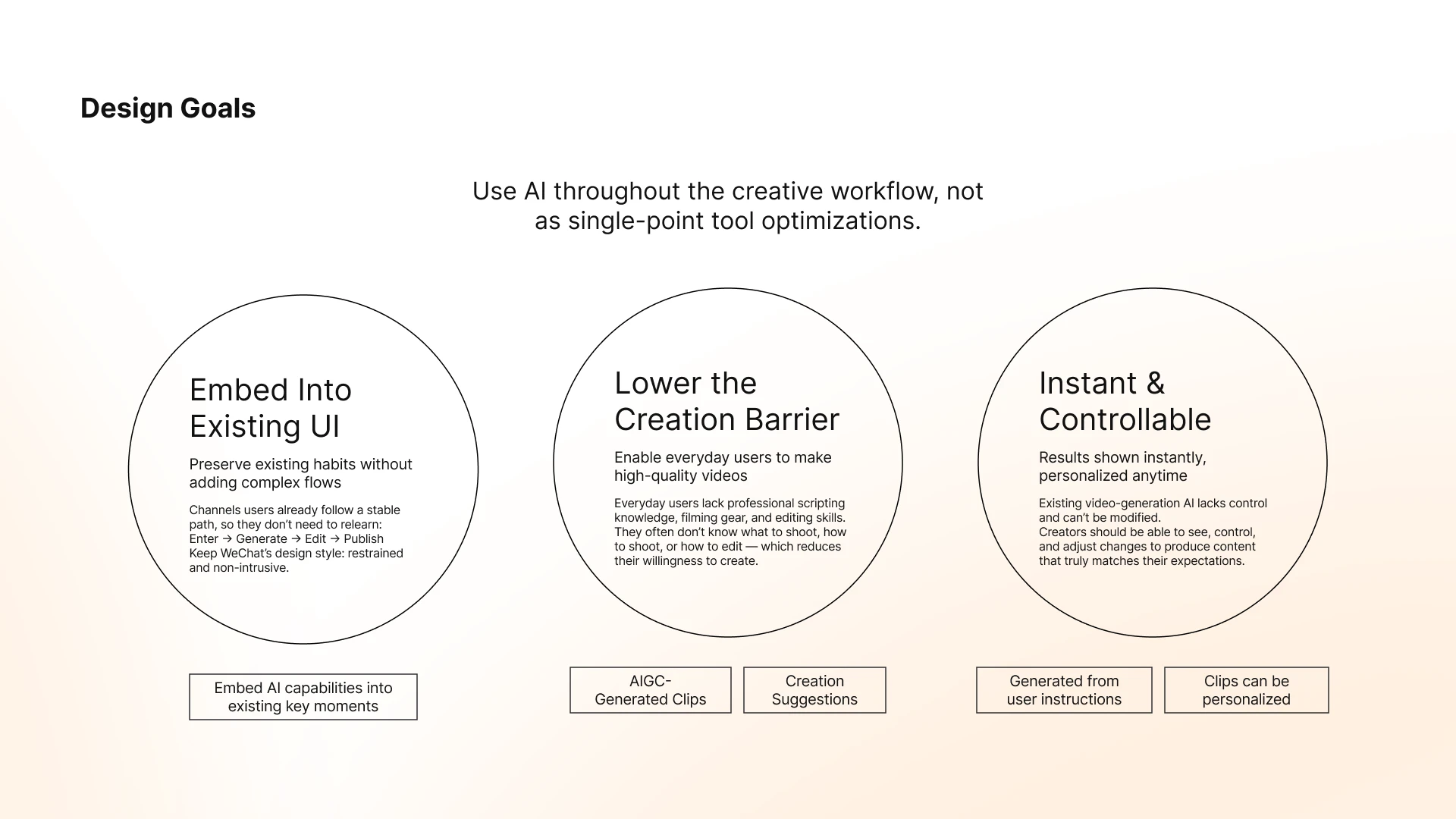
Use AI throughout the creative workflow, not as single-point tool optimizations.
Embed into the existing UI
Creators already follow a stable path — enter, generate, edit, publish — so AI should appear at those moments rather than add new flows, keeping WeChat's restrained style.
Lower the creation barrier
Everyday users often don't know what to shoot, how to shoot it, or how to edit it — which reduces their willingness to create at all.
Instant and controllable
Generated results should appear instantly, and creators should be able to see, control, and adjust them until they match what they meant.
Design
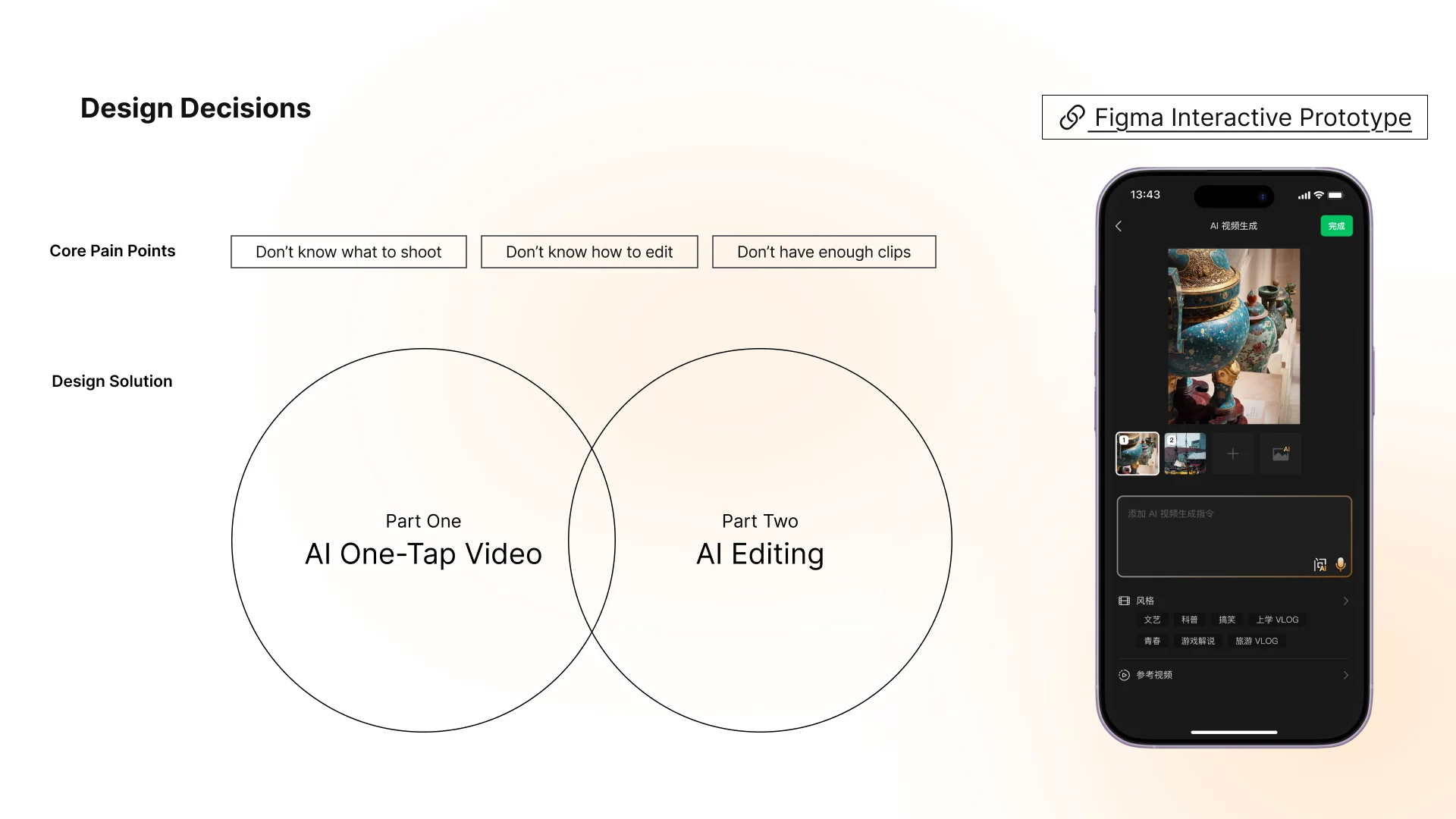
Three pain points — don't know what to shoot, don't know how to edit, don't have enough clips — answered in two parts.
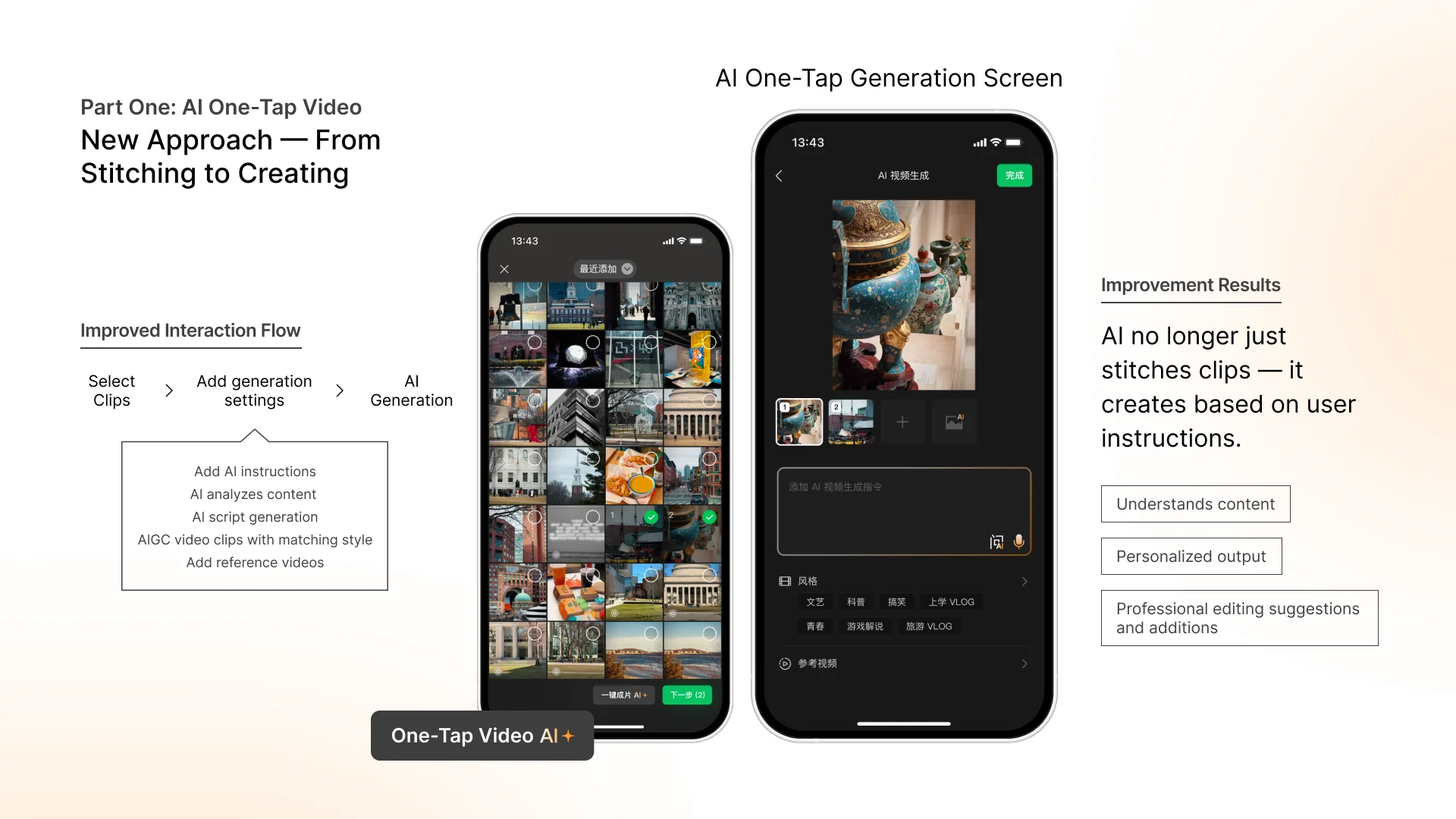
Part one — AI one-tap video: from stitching to creating
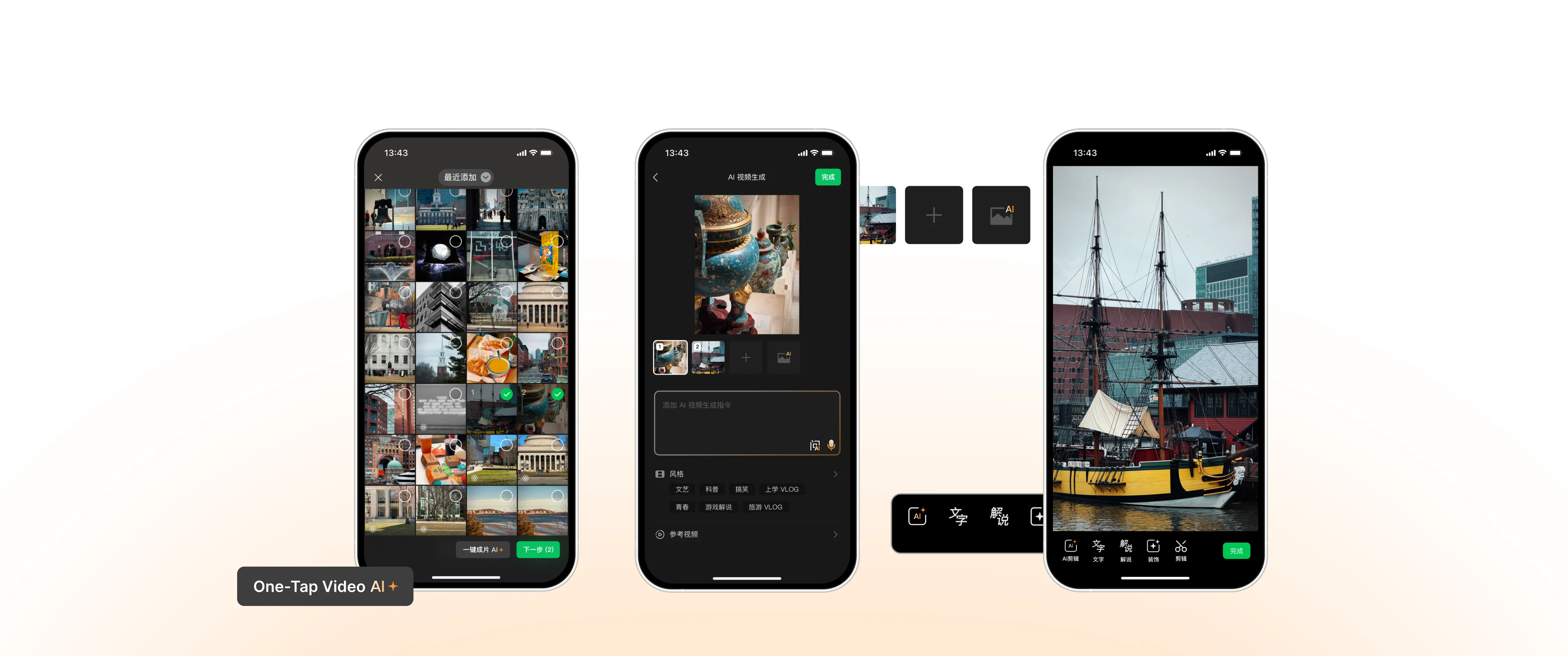
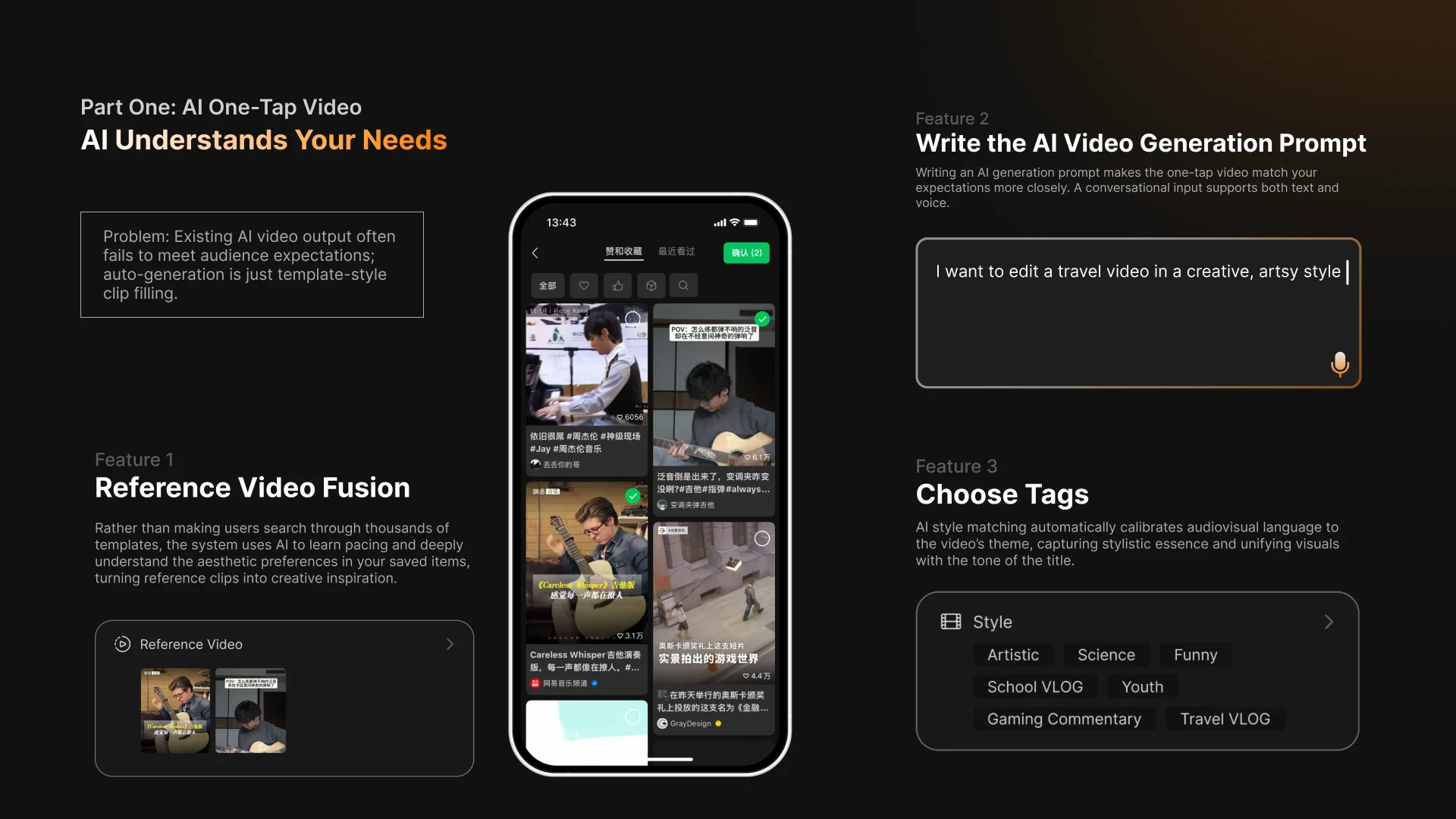
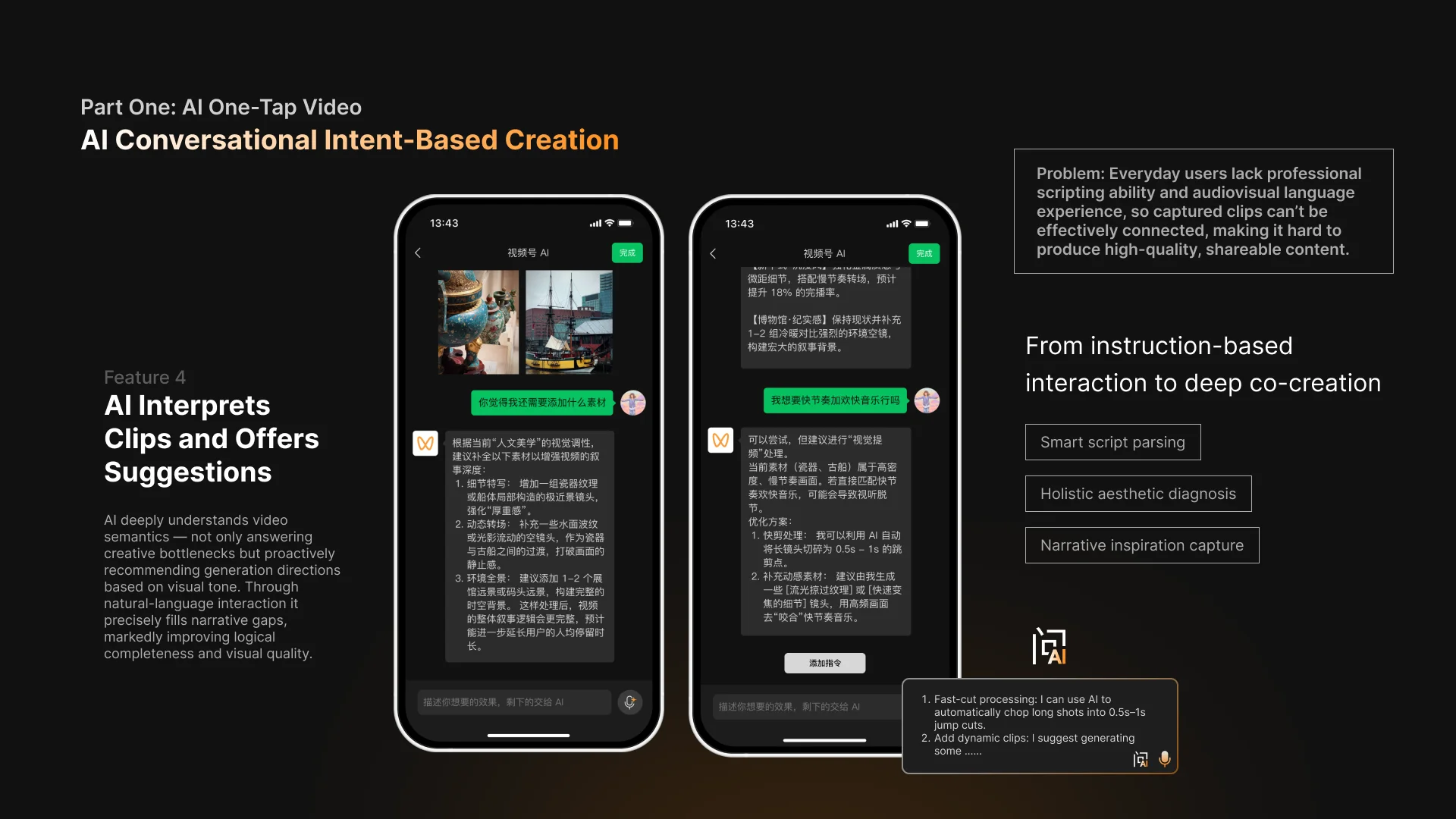
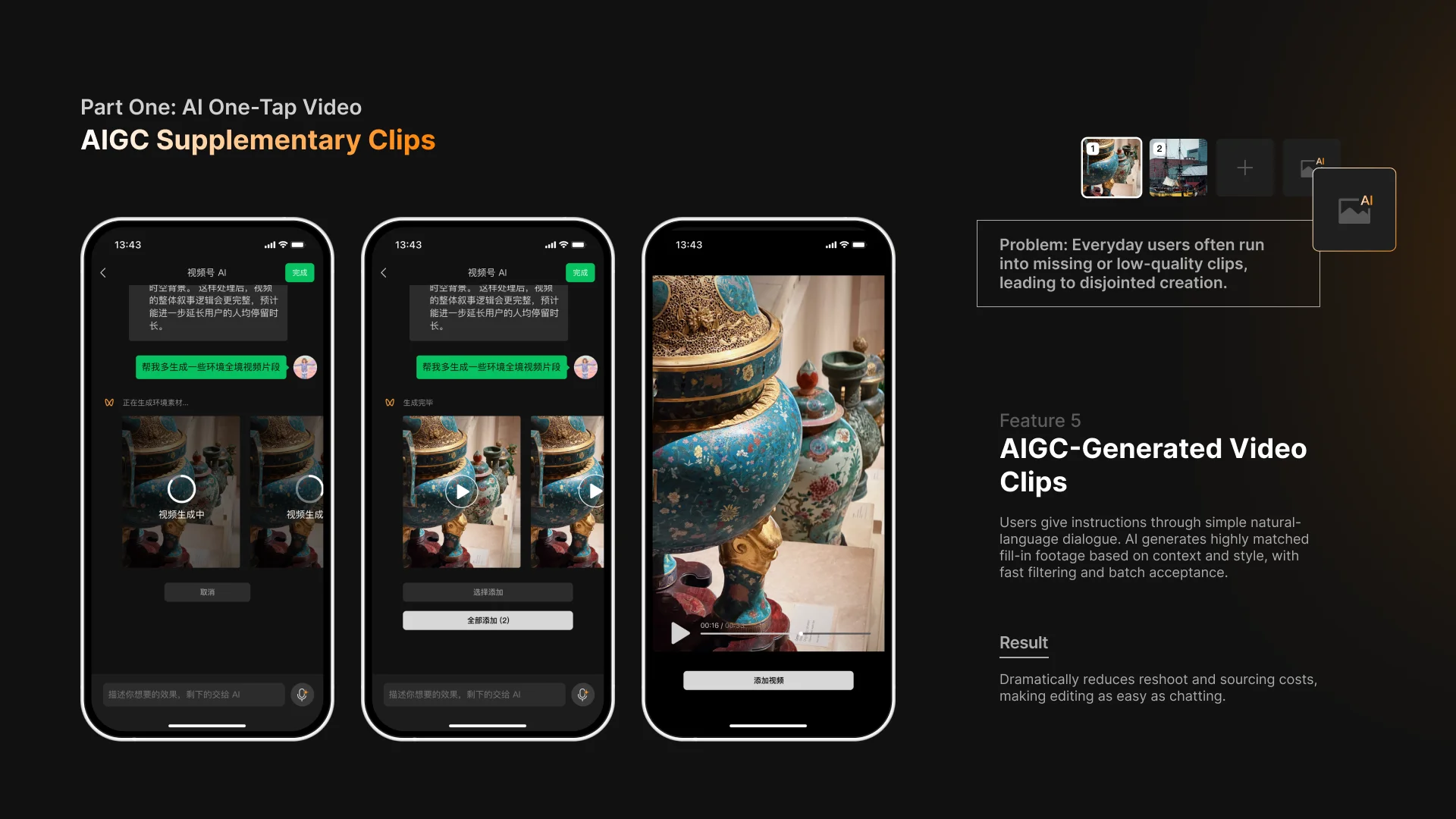
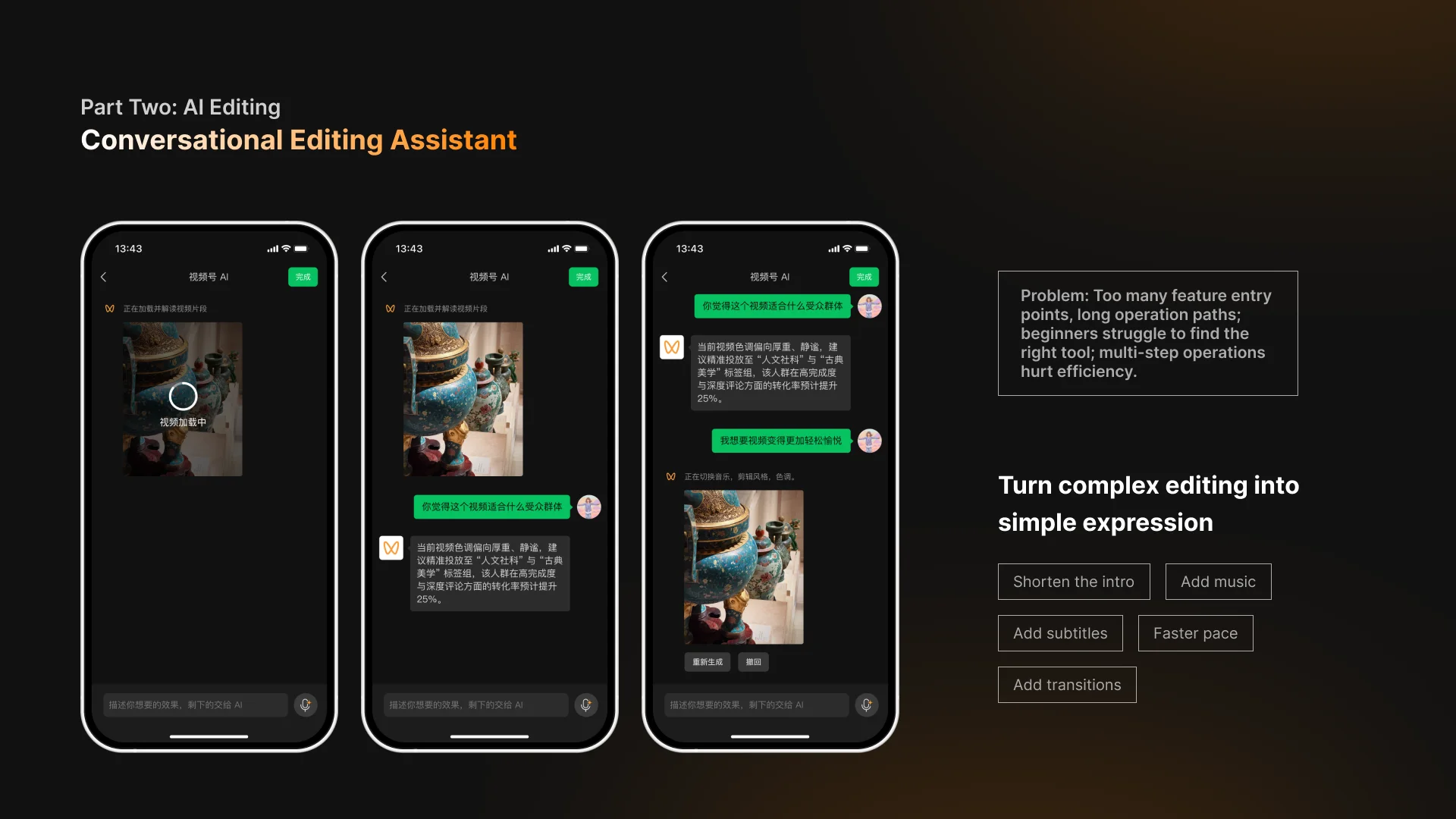
The original flow is select clips → apply template → auto-stitch → publish. The redesign adds a generation step: creators give instructions by text or voice, pick a style or reference video, and AI analyzes the content, writes a script, and generates matching clips. A conversational mode goes further: the AI reads the clips, points out narrative gaps, and suggests what to add — moving from instruction-based interaction toward co-creation.
Part two — AI editing inside the existing editor
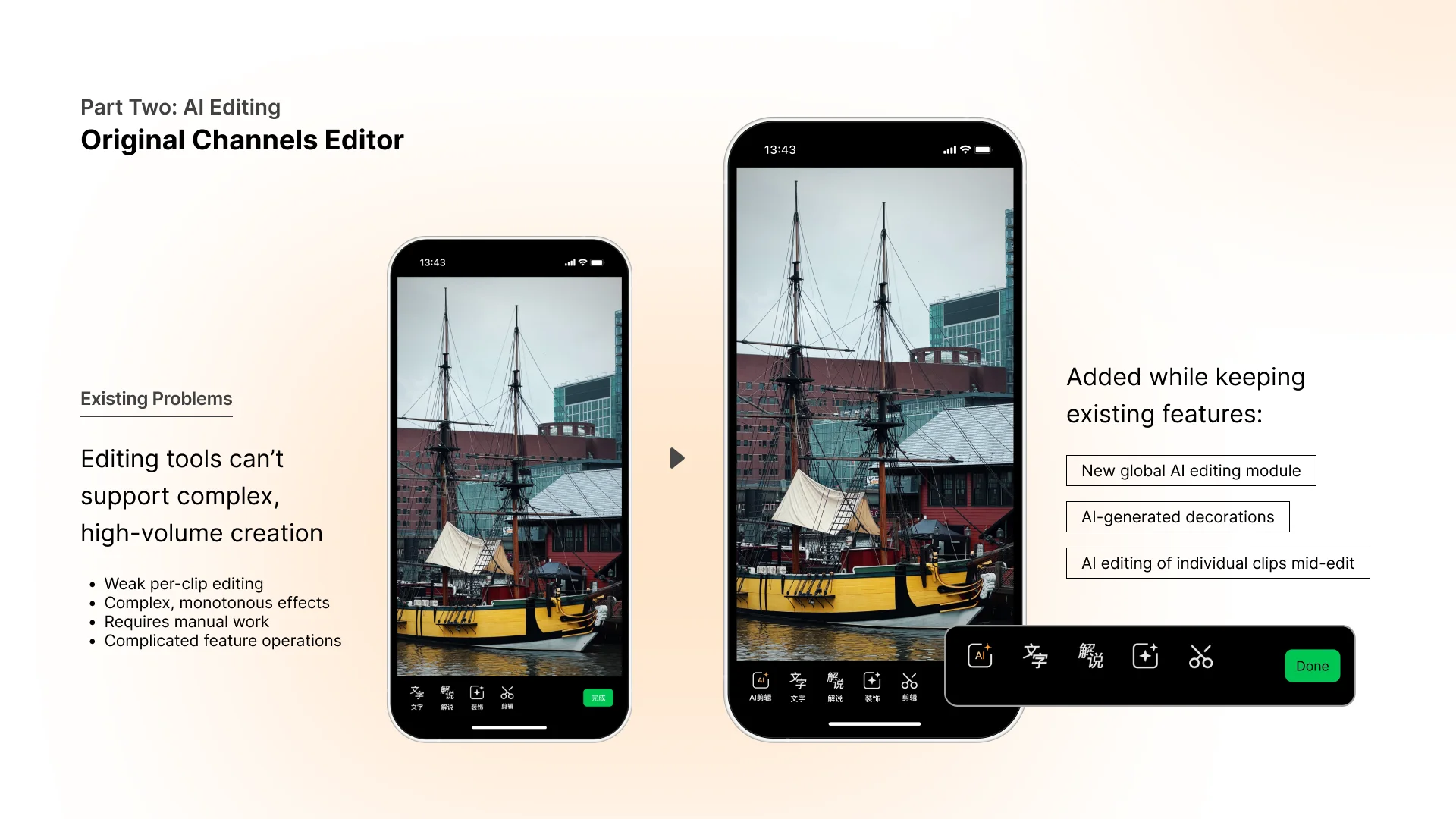
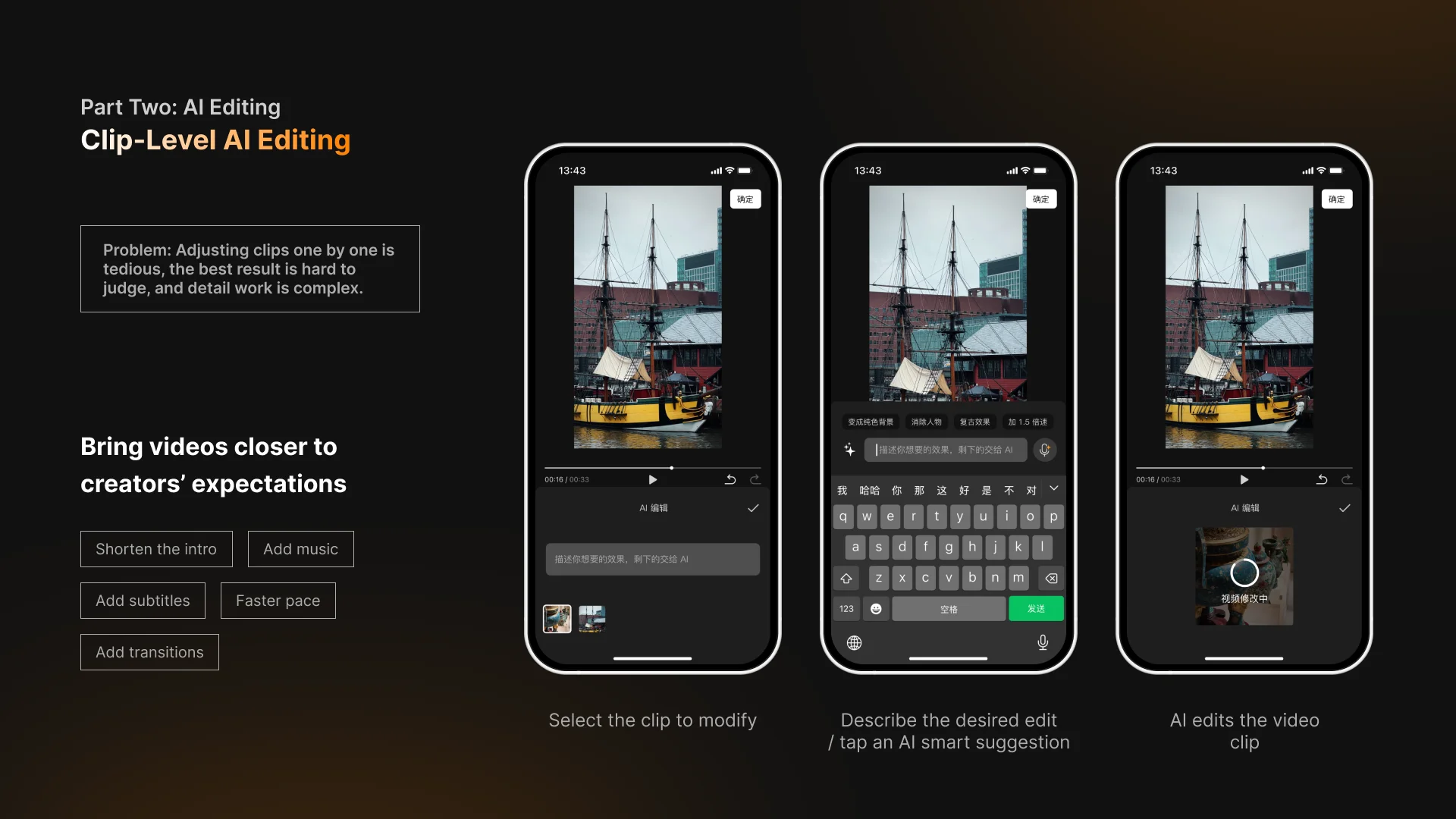
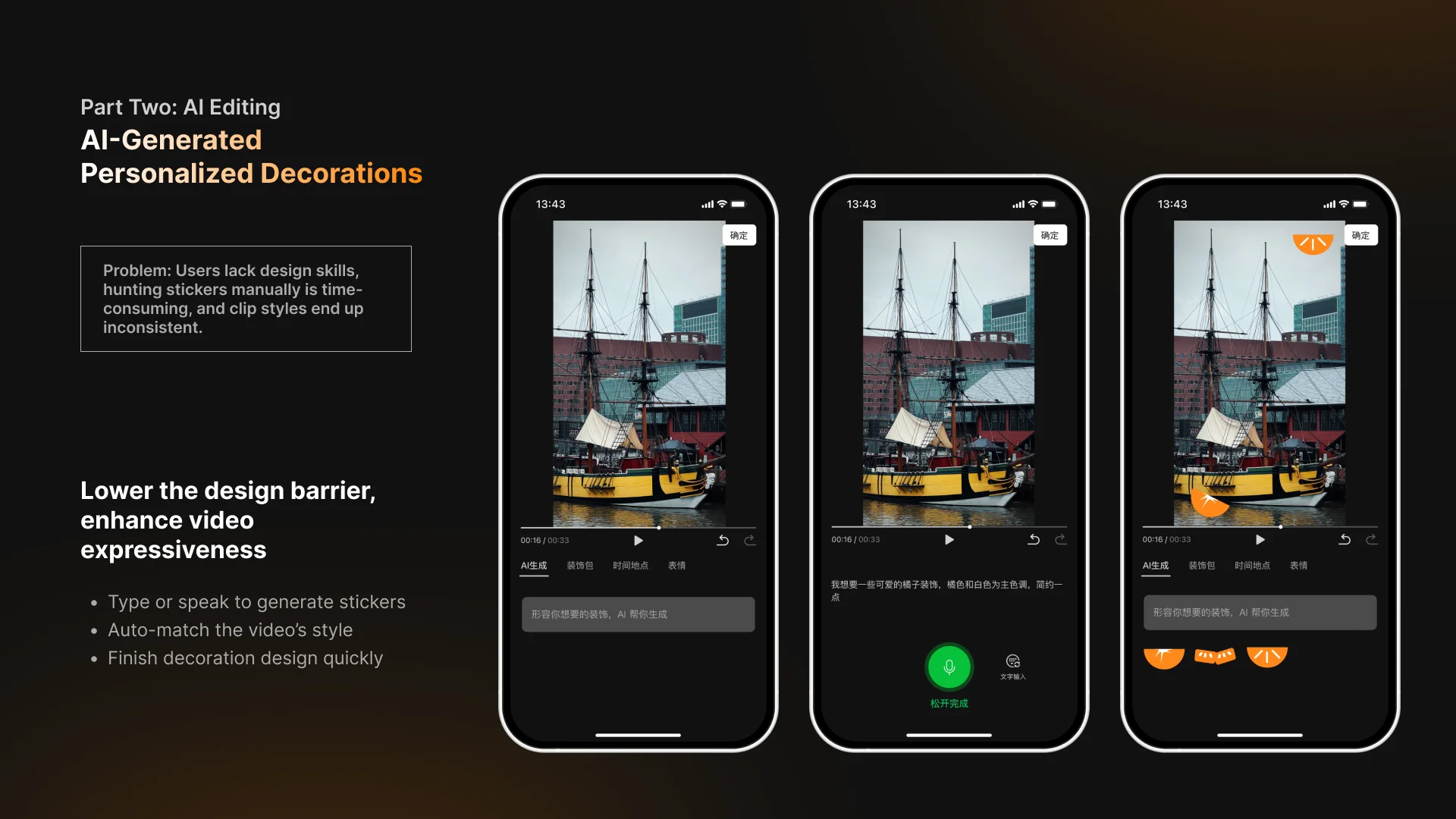
Keeping every existing tool, the editor gains a global AI editing module, AI editing of individual clips mid-edit, and personalized decorations generated from a typed or spoken description that match the video's style.
Principles
Three principles for introducing AI into a familiar creative flow — the main contribution of this work.
01 · Protect creative ownership
The creator remains the author. AI should provide inspiration and remove repetitive work, while people retain control over the idea, emotional tone, and final decision.
02 · Fit the existing habit
AI belongs inside the familiar Channels flow, not beside it as another complicated tool. Every intervention should make creating easier while preserving WeChat's restraint.
03 · Improve taste in context
Strong multimodal models are a starting point. Future iterations should learn the visual language of specific creator communities, from everyday skills to cultural-heritage content.
These echo earlier work on mixed-initiative interfaces (Horvitz, 1999): the question is not only what AI can do, but when it should act, when it should suggest, and how easily a person can undo it.
Discussion
Limitations
This is a speculative proposal made solo within a design challenge. It has not been tested with Channels creators, and the generation quality it assumes depends on models that are still improving.
Open questions
- When AI proposes the story, how much of the result do creators still feel is theirs?
- Does conversational co-creation help beginners, or does it make every video converge on the same style?
- How would creators judge the principles above after a week of using the prototype?
The same question — what stays with people as AI does more of the making — runs through AI Brand Kit and AIGC Video Automation.
References
- Horvitz, E. (1999). Principles of Mixed-Initiative User Interfaces. Proceedings of CHI 1999.