
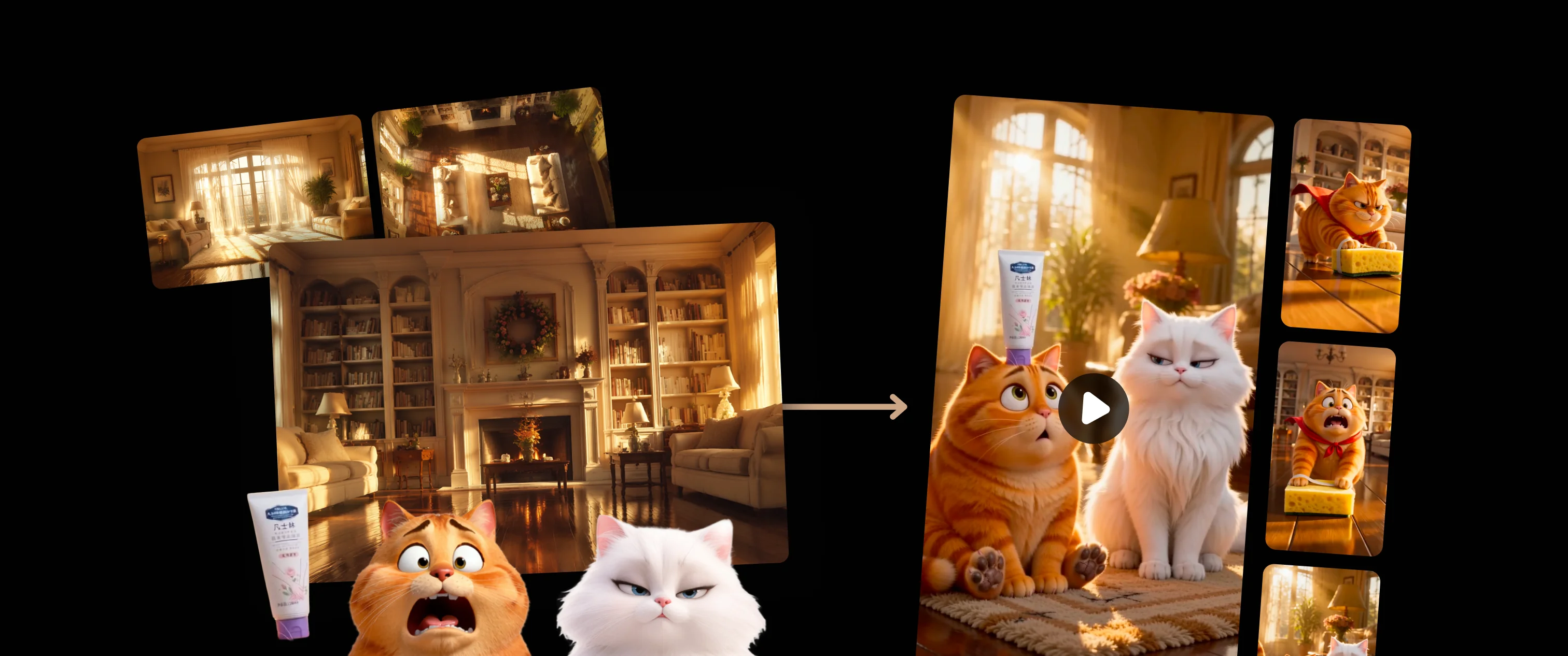
2026
AIGC Video Automation
Creating a reusable workflow for generating trend-led video ads.
- Timeline
- Jun – Aug 2026
- Team
- 2 Designers, 1 Product Manager, 1 Developer
- Role
- AI Product Design Intern @TikTok
- Methods
- Format exploration, AI workflow design, prompt engineering, live ad delivery
Research questionCan product data and cultural trends be turned into platform-native video ads automatically — and where does a person still need to step in?
Abstract
Short-form ads live or die on whether they feel native to the feed — which usually means human creators, agencies, and time.
With the TikTok User Growth team, we explored whether generative video models could turn a product brief and trend signals into e-commerce ads. I tested five video formats, built a workflow that goes from product information to plot, script, characters, scenes, and finished clips, and engineered the prompts at each step. In live delivery, the generated ads outperformed agency-made and other production-path baselines, and TikTok is now automating the workflow.
Context
Generative video can now produce a convincing clip. Producing a whole ad — a story, a consistent character, a product shown correctly — is a workflow problem, not a single prompt.
The goal was twofold: make ads that perform, and build a workflow that could later generate them at scale with little or no human intervention. That meant deciding which ad structures suit generation at all, before trying to automate them.
Method
01 — Explore formats before automating them
I tested five routes — short-drama insertion, rapid remix, AI short drama, animation, and IP-led — to understand where each structure could create attention for a product, and how reliably each could be produced through a workflow.
02 — Build the workflow
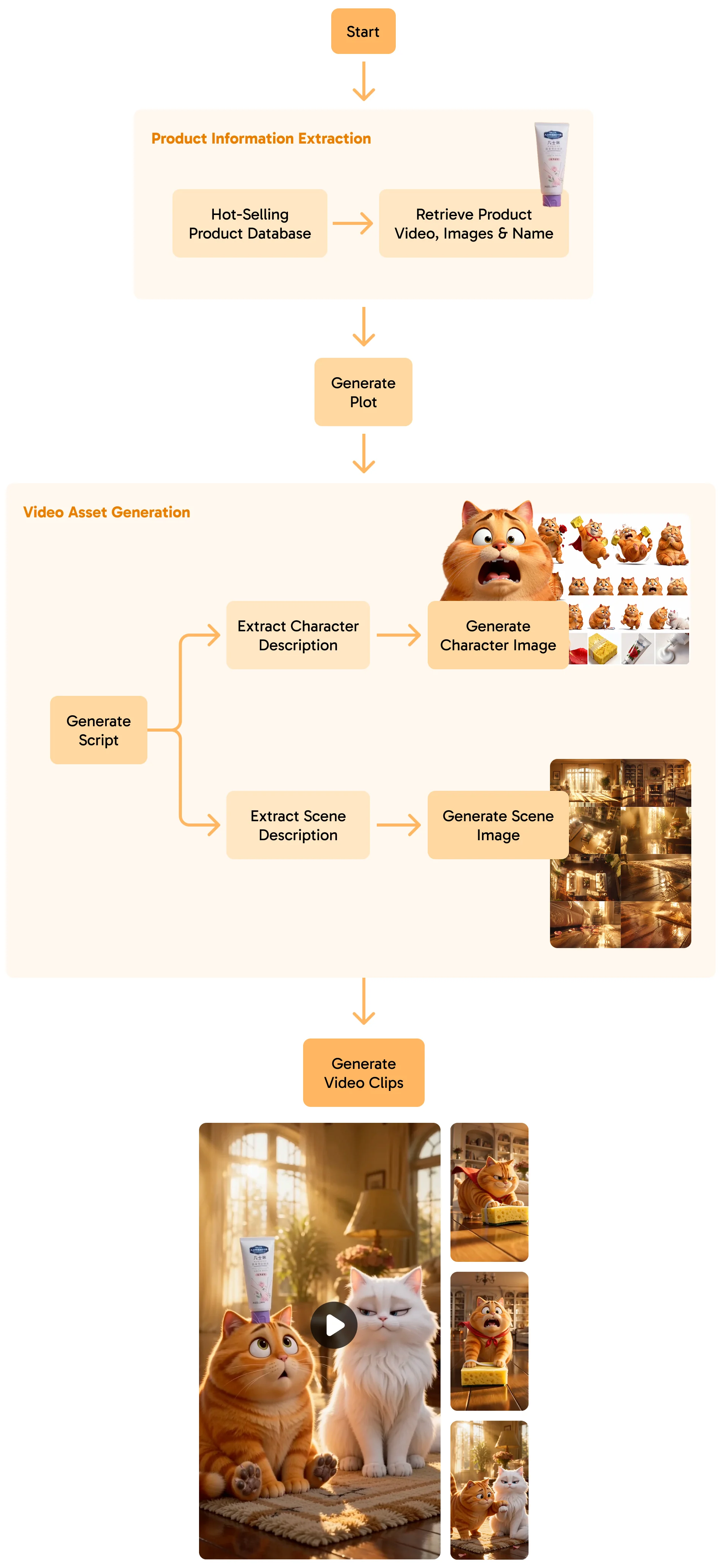
I broke the ad into steps a model could do reliably on its own: extract the product, generate the plot and script, generate character and scene assets, generate clips, and assemble the final video.
03 — Prompt engineering at each step
I wrote and revised prompts for plot, script, character, and scene descriptions so the steps stayed consistent with one another and could be reused across products.
04 — Deliver and measure
Generated ads ran as live campaigns on TikTok and were compared with ads from other production paths.
System
A creative automation workflow that turns one product brief into several ad-video directions.
Findings
The generated ads outperformed the baselines — and the result changed what the team built next.
Delivery results
Generated materials outperformed agency-made and other production-path baselines. On average, a single creative drove 400+ new additions and ~7k in spend on TikTok.
From workflow to automation
TikTok is putting the workflow into automation to create similar videos at scale, and is developing a system that captures hot topics and high-performing videos and turns them into new workflow templates.
Discussion
Let performance shape the next template
The most valuable output is not one video; it is a system that learns from strong results and produces the next template faster. Creative direction shifts from making each ad to deciding what the system should learn from.
Limitations
Performance was measured in a commercial setting over a short period, and details are limited by confidentiality. Ad performance also says little about how viewers perceive AI-generated content, or how it should be disclosed to them.
Open questions
- Which creative decisions should stay with people when a workflow can generate ads end to end?
- How should AI-generated ads be disclosed, and does disclosure change how they perform?
- Can a workflow keep up with culture, or will it always optimize for last week's trend?
The same tension — automation versus human authorship — runs through WeChat Channels × AI.
Contribution
I explored and evaluated the video formats, built the generation workflow, and wrote the prompts for plot, script, character, and scene.
Tools: image and video generation models, AI workflow tools, prompt engineering.