
2025
Palette U
A website to record your memories and store them in your own 3D memory palace.
- Timeline
- Oct 2025 – Jan 2026
- Team
- Personal project
- Role
- Designer, Full-Stack Developer & Researcher
- Methods
- Interviews (20+), market analysis, 3D prototyping, public release
Research questionCan a spatial metaphor — a memory palace you build yourself — make recording memories feel more personal and easier to keep up?
Abstract
We are flooded with new information and experiences, while the moments that matter most quietly fade away.
Interviews with 20+ people who journal or keep diaries showed that memories are relational, organized by person, place, or life stage, and easily lost when capturing them takes effort. Palette U turns these findings into a website where people record memories quickly and arrange them as islands in their own 3D memory palace, with a “memory train” that brings random memories back. It began as the final project for NYU's Networked Media and Intro to Three.js courses and grew into a complete personal project, reaching 2,000+ views after launch.
Context
Placing memories in imagined space is one of the oldest memory techniques there is.
The method of loci — the “memory palace” — uses familiar places to hold things one wants to remember (Yates, 1966). In HCI, work on everyday reminiscence such as Pensieve (Peesapati et al., 2010) showed that small, unprompted triggers can lead people to revisit and value their own past. Existing memory and journaling apps mostly offer a feed or a calendar; few give people a space of their own to organize memories in.
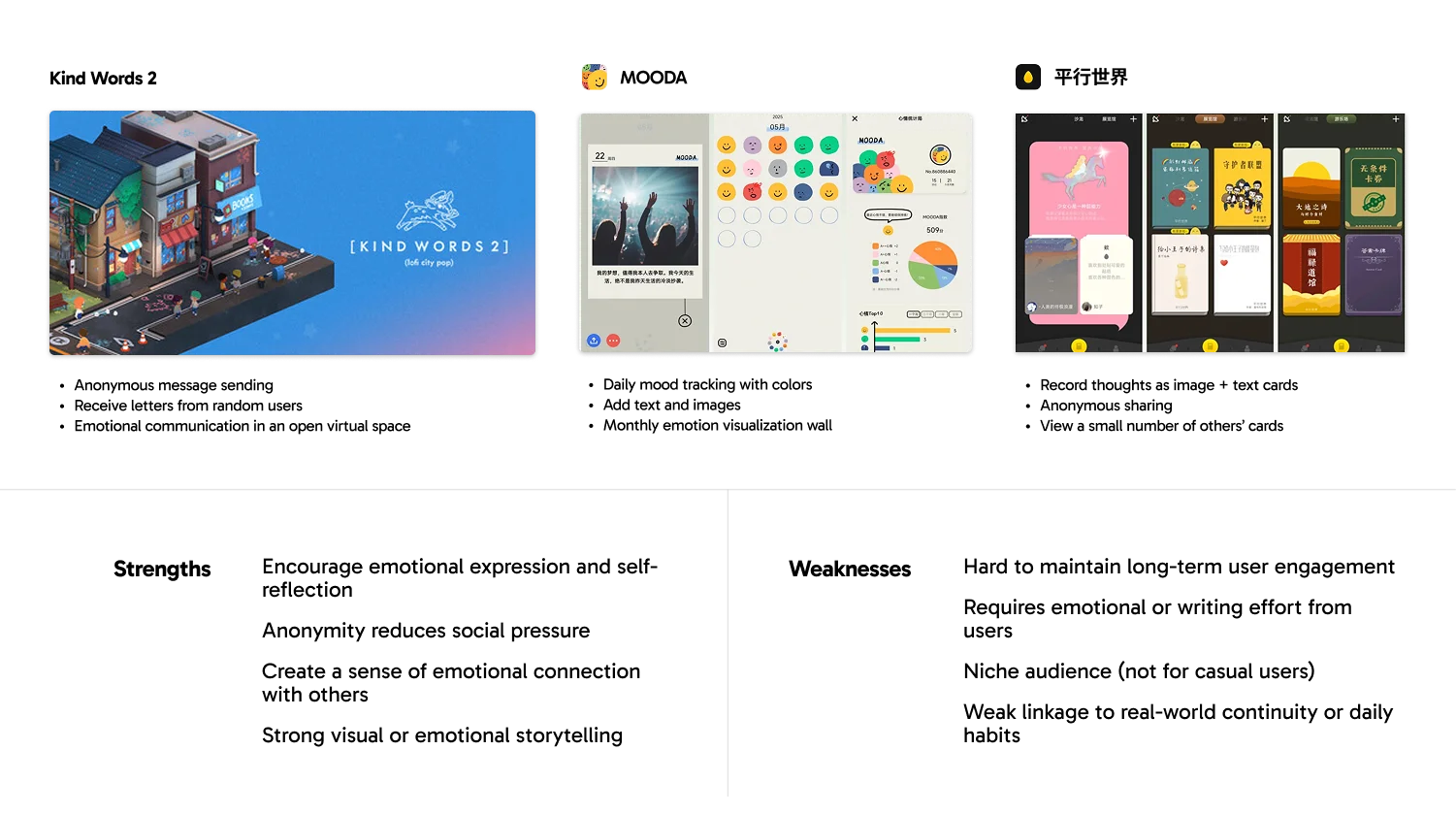
Gap: a memory-palace experience that makes storing effortless while keeping a clear and meaningful organization.
Method
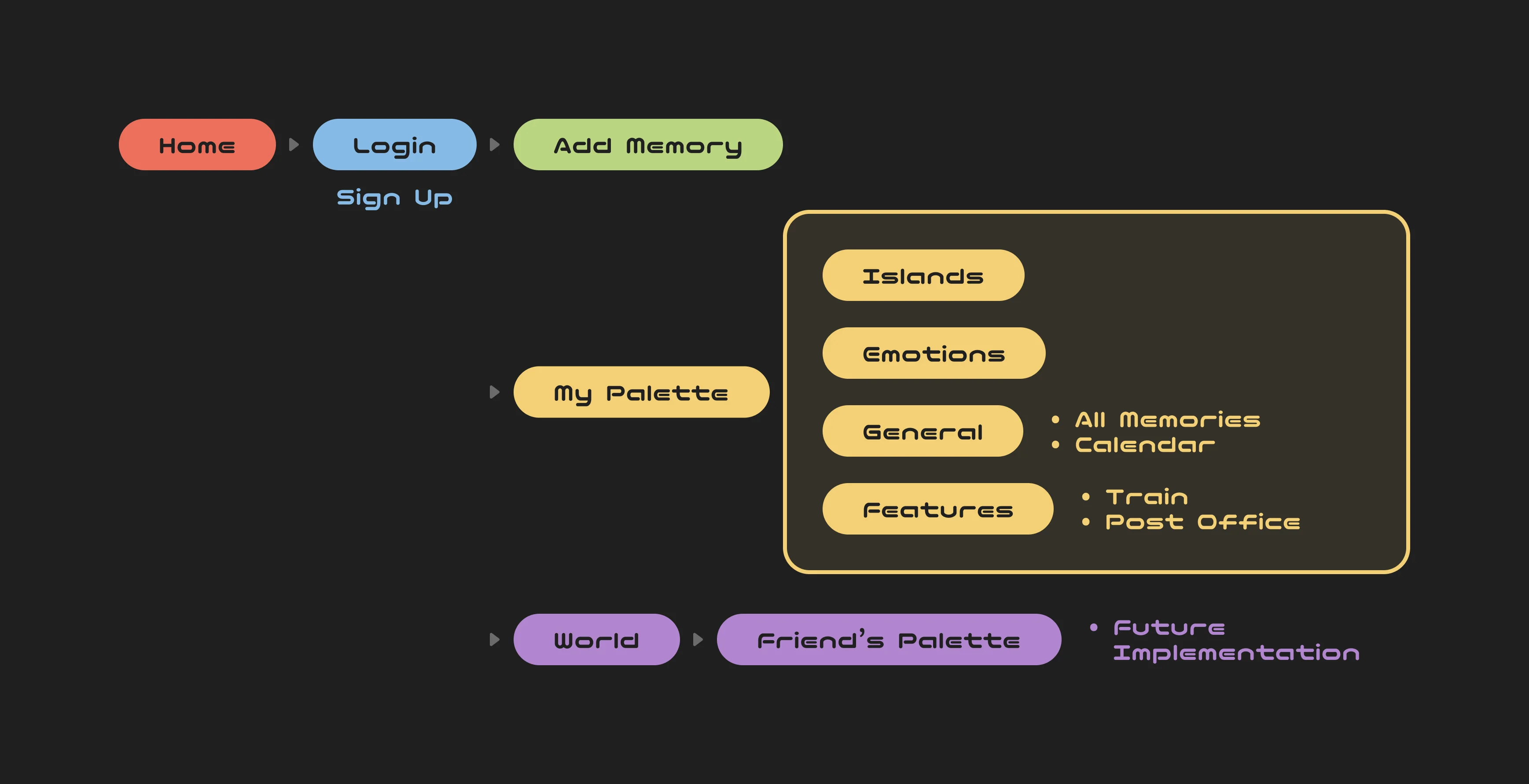
I interviewed 20+ teenagers, students, and young adults who journal or keep a diary about how they relate to their memories and what stops them from preserving them. Alongside the interviews, I compared existing memory apps, mapped the site structure, and built the palace iteratively in Blender and Three.js.
Formative findings
Memory is relational
- Memories are most meaningful when tied to people and relationships.
- People want to revisit and share memories with others.
- Small triggers (a song, a drink) spark a whole wave of nostalgia.
Context and organization matter
- People think in categories — by person, place, or life stage.
- A timeline view helps people navigate rather than just scroll.
- Linked memories show the full picture of a moment.
Friction kills the habit
- People are too busy for lengthy journaling rituals.
- The best capture methods are fast and low-effort.
- Even a single random photo can revive a full memory.
Design
Each part of the palace answers one of the findings.
Quick capture → friction kills the habit
Adding a memory is kept short, and everything can be browsed together afterwards.
Memory islands → context and organization
People create islands for the important parts of their lives — a person, a place, a life stage — and arrange their memories there.
Memory train → small triggers
A customizable dashboard lets each memory show what it means to its owner, and the memory train resurfaces random memories, the way a song or a photo does.
Discussion
Space as organization
A 3D palace turns categories into places. Whether that makes memories easier to find — or simply more pleasant to keep — is the question this project raises but has not yet answered.
Limitations
Palette U has not been evaluated with users over time. The 2,000+ views measure reach, not whether people kept recording memories or found the spatial layout more meaningful than a list. It was also my first Three.js and backend project, which limited how far the 3D interaction could go.
Open questions
- Does arranging memories in space help people recall them, or mostly make recording feel meaningful?
- What should a memory palace look like when it is shared with the people in it?
- How often should a system resurface a memory before it stops feeling like a gift?
Like interTabs and Cosma Sense, this asks how tools can hold on to what matters for people.
Contribution
A solo project. I did the research, design, and development:
- Research — user interviews and market research.
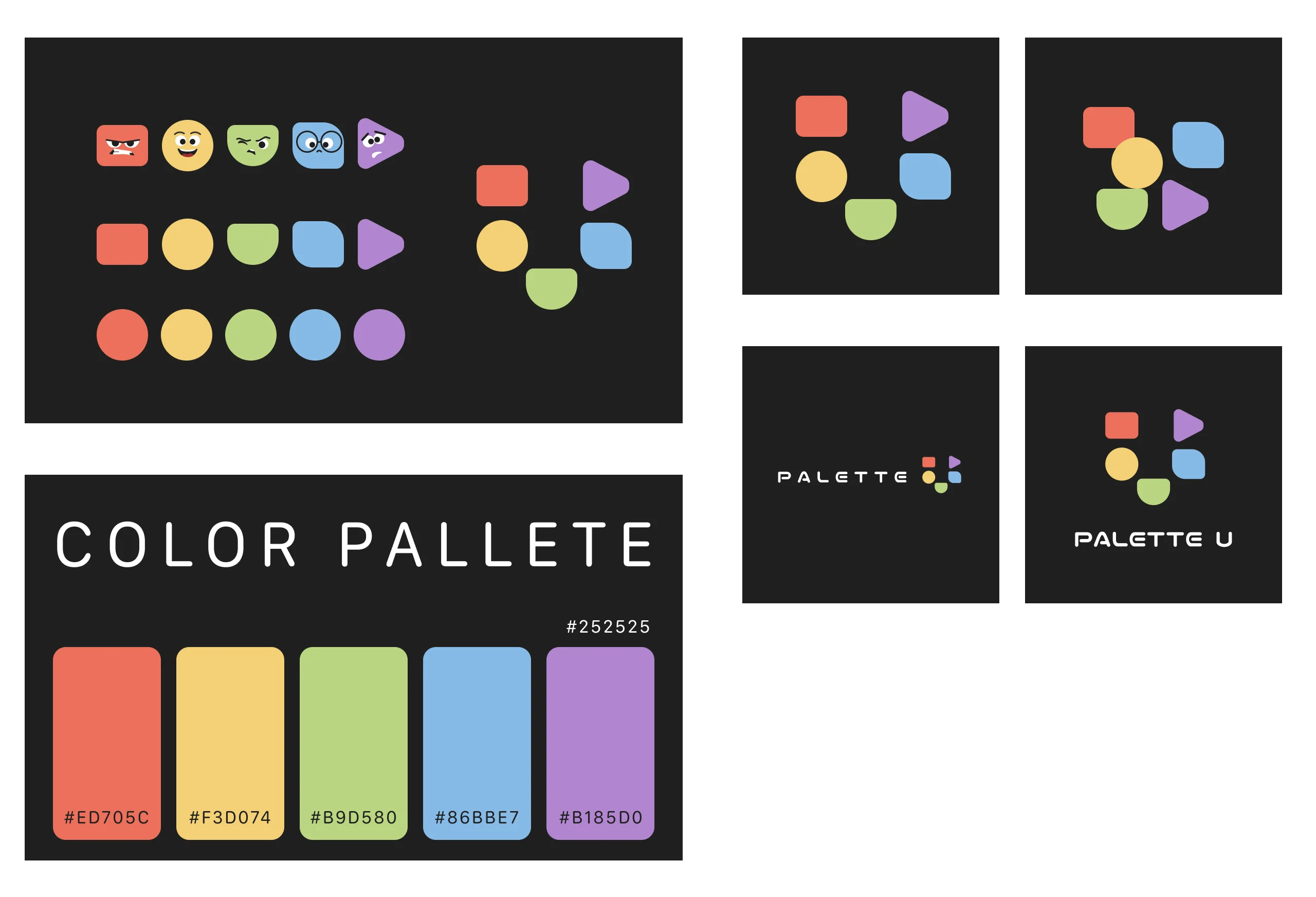
- UI/UX design & 3D modeling — the website, the logo, and the memory islands, modeled in Blender.
- Frontend & Three.js — the 3D visualization and interaction.
- Backend — Express.js and MySQL to store user data and the memory islands.
- Launch — marketing materials that brought the project 2,000+ views.
Tools: Three.js, HTML/CSS, JavaScript, Blender, Figma, Express.js, SQL.
References
- Peesapati, S. T., Schwanda, V., Schultz, J., Lepage, M., Jeong, S., & Cosley, D. (2010). Pensieve: Supporting Everyday Reminiscence. Proceedings of CHI 2010.
- Yates, F. A. (1966). The Art of Memory. Routledge & Kegan Paul.