
2026
Cosma Sense
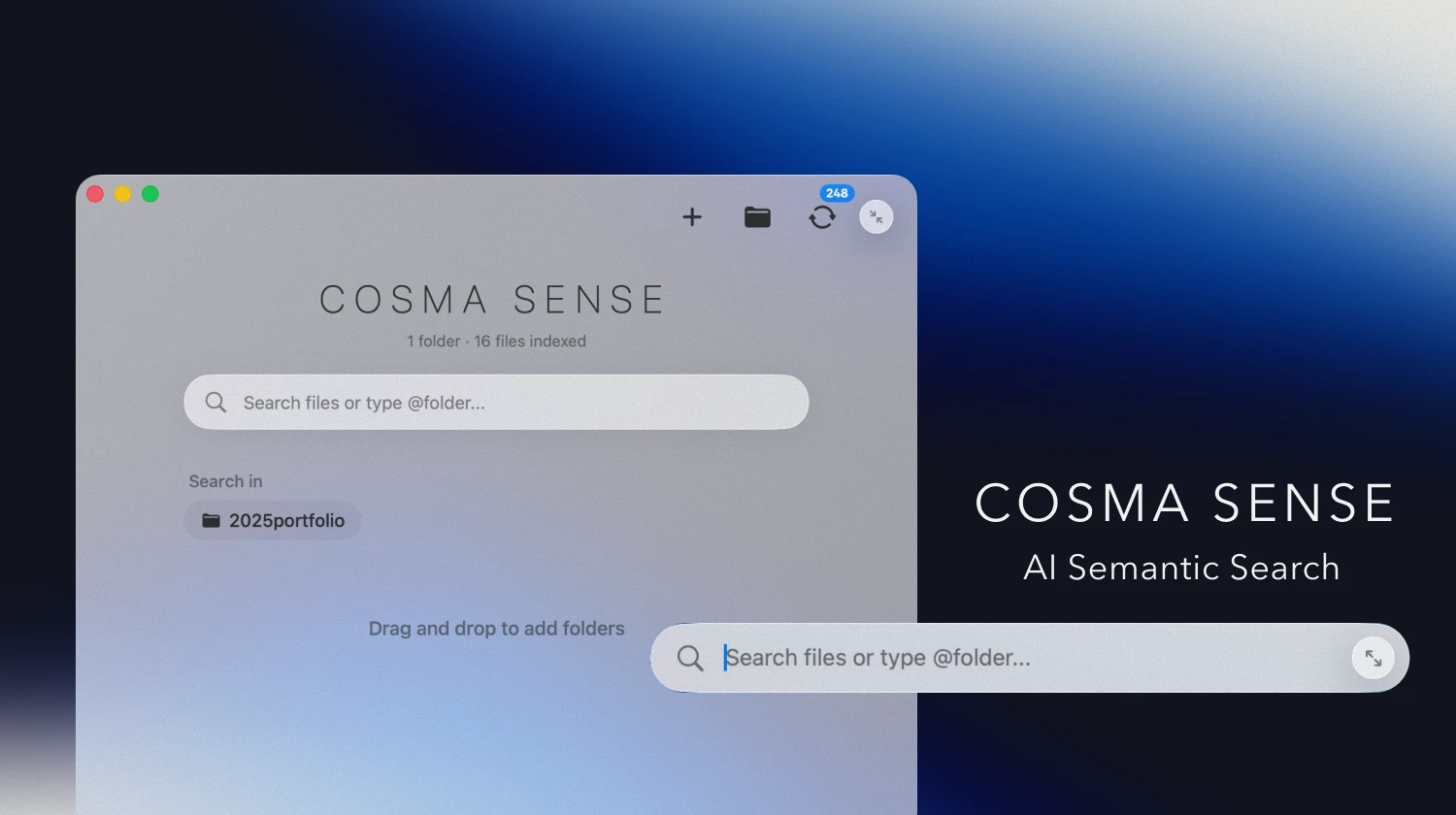
A local-first, AI-powered search engine that indexes your files and lets you find information semantically.
- Year
- 2026
- Role
- Product Designer & Frontend Developer
- Platform
- macOS app + landing page
- Methods
- Product design, working prototype
Research questionHow can people find their own files by what they remember about them — without handing those files to the cloud?
Abstract
We rarely remember where we saved something. We remember what it looked like, what it was about, or when we last used it.
Desktop search still asks for the first kind of memory: a file name, a folder, a keyword. Cosma Sense indexes the files on a computer and understands what is inside them — images, PDFs, audio, video, and documents — so people can search in natural language for what they remember. It runs local-first, so that semantic understanding of personal files doesn't require uploading them. I designed the product experience and built the landing page.
Context
Re-finding personal information is a long-standing problem in HCI.
Systems like Stuff I've Seen (Dumais et al., 2003) showed the value of a single index across a person's email, files, and web pages, searched by the cues people actually remember. At the same time, studies of search behaviour (Teevan et al., 2004) found that people often prefer to navigate step by step to a known location rather than type a query. Cosma Sense sits in that tension: modern language and vision models make meaning-based search far more capable than keyword search, but they raise a new question about where personal data is processed.
Design
Four interactions, from indexing a folder to using the file you found.
Drop a folder. See everything inside.
Drag in a folder and AI analyzes its contents, generating summaries and previews you can quickly scroll through.
Search by what you remember
Type natural language like “the receipt from last night” or “the file with the blue logo” and find the right file.
Work across every file type
Images, PDFs, audio, video, and documents are understood from one unified interface.
Every search becomes a clear flow
Drag results directly into emails, browser uploads, or other apps without digging through folders.
Discussion
Local-first as a design constraint
Keeping indexing on the device protects files that are often the most personal data a person owns, but it limits which models can run and how fast. That trade-off is part of the design, not only the engineering.
Limitations
Cosma Sense has not yet been evaluated with users. We don't yet know how often semantic results match what people meant, or whether people trust a search they can't see the logic of.
Open questions
- When a semantic match is wrong, how should the interface help someone recover?
- Does searching by memory change how carefully people organize their files in the first place?
- How much does “local-first” matter to people when they decide whether to trust an AI with their files?
This continues the question behind interTabs: how tools can hold on to information for people, instead of asking them to.
Contribution
- Product design — the product experience of the macOS app.
- Branding — the visual identity.
- Frontend development — the landing page, built in Nuxt with GSAP.
References
- Dumais, S., Cutrell, E., Cadiz, J. J., Jancke, G., Sarin, R., & Robbins, D. C. (2003). Stuff I've Seen: A System for Personal Information Retrieval and Re-Use. Proceedings of SIGIR 2003.
- Teevan, J., Alvarado, C., Ackerman, M. S., & Karger, D. R. (2004). The Perfect Search Engine Is Not Enough: A Study of Orienteering Behavior in Directed Search. Proceedings of CHI 2004.